Navigation Systems of Modern Aircraft
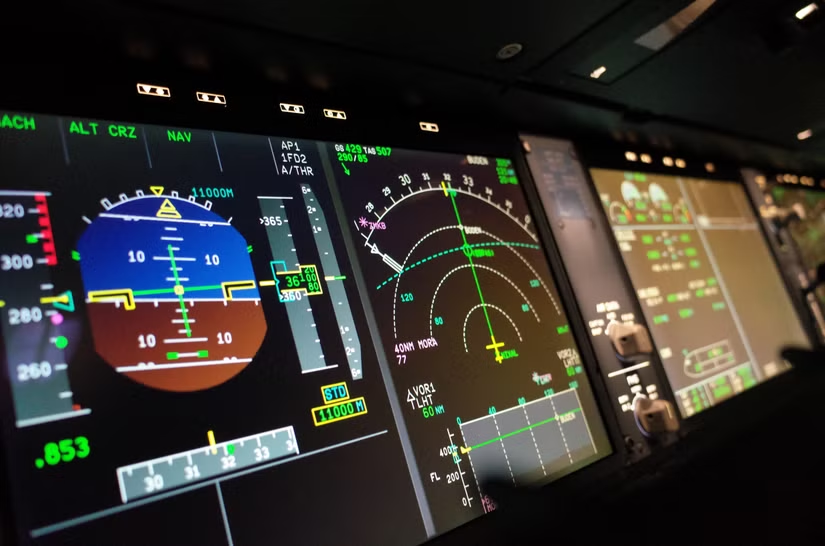
Modern commercial aircraft rely on a highly integrated suite of navigation systems to determine position, guide flight paths, and ensure safe and efficient operations across all phases of flight. Unlike early aviation, where pilots depended primarily on visual references and basic radio aids, today’s flight decks combine satellite-based navigation, inertial systems, and radio navigation into a single, continuously cross-checked solution.
From Conventional Navigation to Integrated Avionics
Historically, aircraft navigation was centred on ground-based radio aids such as Non-Directional Beacons (NDBs) and VHF Omnidirectional Range (VOR) stations. While these systems are still available in many regions, modern aircraft increasingly depend on area navigation (RNAV) and performance-based navigation (PBN), which allow aircraft to fly precise routes independent of the direct location of ground stations.
This transition has enabled more efficient airspace design, reduced fuel burn, and improved traffic flow management, particularly in congested terminal areas.
Global Navigation Satellite Systems (GNSS)
At the core of modern navigation lies GNSS, most commonly GPS, supplemented by other constellations such as Galileo and GLONASS. GNSS provides accurate three-dimensional position and time information anywhere in the world, forming the primary input for the Flight Management System (FMS).
To enhance accuracy and integrity, modern aircraft use augmentation systems such as:
- Satellite-Based Augmentation Systems (SBAS), improving vertical and horizontal precision
- Receiver Autonomous Integrity Monitoring (RAIM), which continuously checks signal reliability
These technologies enable advanced procedures such as RNAV (GNSS) and RNP approaches, including those with curved flight paths and reduced obstacle clearance margins.
Inertial Reference Systems (IRS)
GNSS alone is not sufficient for certified navigation, which is why aircraft are equipped with Inertial Reference Systems. An IRS uses accelerometers and gyroscopes to calculate aircraft position, velocity, and attitude without relying on external signals.
Although inertial systems gradually drift over time, they are continuously updated by GNSS data. This hybrid approach ensures reliable navigation even during temporary satellite signal degradation, such as during polar operations or intentional signal interference.
Flight Management System (FMS)
The FMS acts as the central brain of aircraft navigation. It integrates data from GNSS, IRS, radio navigation aids, and aircraft sensors to compute:
- Lateral and vertical flight paths
- Fuel predictions and time estimates
- Optimal climb, cruise, and descent profiles
Pilots interact with the FMS to enter routes, performance data, and constraints, while the system automatically commands the autopilot and flight director to follow the calculated trajectory.
Radio Navigation Aids
Despite the dominance of satellite navigation, radio navigation aids remain an important redundancy. Modern aircraft can still tune and use:
- VOR and DME for position fixing
- Instrument Landing Systems (ILS) for precision approaches
Many airports continue to maintain these systems to ensure operational resilience in the event of GNSS outages or regulatory requirements.
Required Navigation Performance (RNP)
One of the most significant advances in modern navigation is RNP. Unlike traditional navigation, RNP defines not only accuracy but also onboard monitoring and alerting capabilities.
For example, RNP AR (Authorisation Required) approaches allow aircraft to fly very precise paths in challenging terrain environments, significantly improving accessibility to airports surrounded by obstacles while maintaining high safety margins.
The Pilot’s Role in Automated Navigation
While modern navigation systems are highly automated, pilot oversight remains critical. Flight crews are trained to:
- Cross-check navigation sources
- Monitor system accuracy and alerts
- Revert to conventional navigation if required
Effective use of modern navigation is therefore a balance between automation management and fundamental airmanship.
Conclusion
Navigation systems in modern aircraft represent a remarkable integration of satellite technology, inertial sensors, and advanced computing. These systems have transformed how aircraft operate, enabling safer, more efficient, and more environmentally responsible aviation. As airspace continues to evolve and traffic volumes increase, navigation technology will remain a cornerstone of modern flight operations.
This article is intended as a general overview for aviation enthusiasts and does not replace official flight training or operational documentation.